What it is
Running rigging is the rope and movable tackle used to raise, shape and reduce sails. A halyard raises a sail; a sheet controls its angle; an outhaul tensions the mainsail foot. A reefing line pulls a slab-reefed sail's new tack or clew down, but an in-mast main has no fixed reef points and instead uses an outhaul plus a furling line. A furling line rotates a headsail drum or mainsail mechanism. The vang controls boom height and twist; the traveler moves the mainsheet's lower attachment sideways. Control lines pass through blocks (pulleys), deck organizers, rope clutches and winches.
Polyester double braid is durable and economical for sheets. Halyards and heavily loaded controls often use a low-stretch Dyneema core under a polyester cover. Diameter must suit not only breaking load but also hands, winch self-tailers, clutches and sheave grooves.
Owner learning layer
line function, material and failure
Mental model
A line is only one part of a control system. Load passes through a sail attachment, the line’s core, sheaves and blocks, organizers, clutch and winch into deck structure. A high-strength line can still fail because it is too small for a clutch, bends around an undersized sheave, overheats during easing or chafes at one fixed point. Map every line from end to end and label both ends.
Tradeoffs
Polyester is forgiving, UV-resistant, grippy and economical but stretches. Dyneema-core line reduces stretch and weight, improving halyard and reef control, but costs more, can slip in unsuitable clutches and may expose a load-bearing core once the cover is damaged. Larger diameter is comfortable and holds better but adds friction and may not fit sheaves; smaller line runs freely but can be unpleasant or unsafe to handle. Cockpit-led controls reduce trips forward but add friction, hardware and failure points. Simple deck leads may work better if the crew can use them safely.
Maintenance competence
Know the purpose, diameter, construction and finished length of every critical line. Inspect working sections at mast exits, spreaders, clutches and sheaves; end-for-end a suitable line before one spot is destroyed; wash salt from ropes; service the hardware causing recurring chafe. Never pull a halyard out without a secure messenger. Carry enough compatible line to replace a reefing or furling control and at least one way to hoist each primary sail if its normal halyard is lost. Practice a splice appropriate to the line you actually own—or know which strong temporary knot and derating you are accepting.
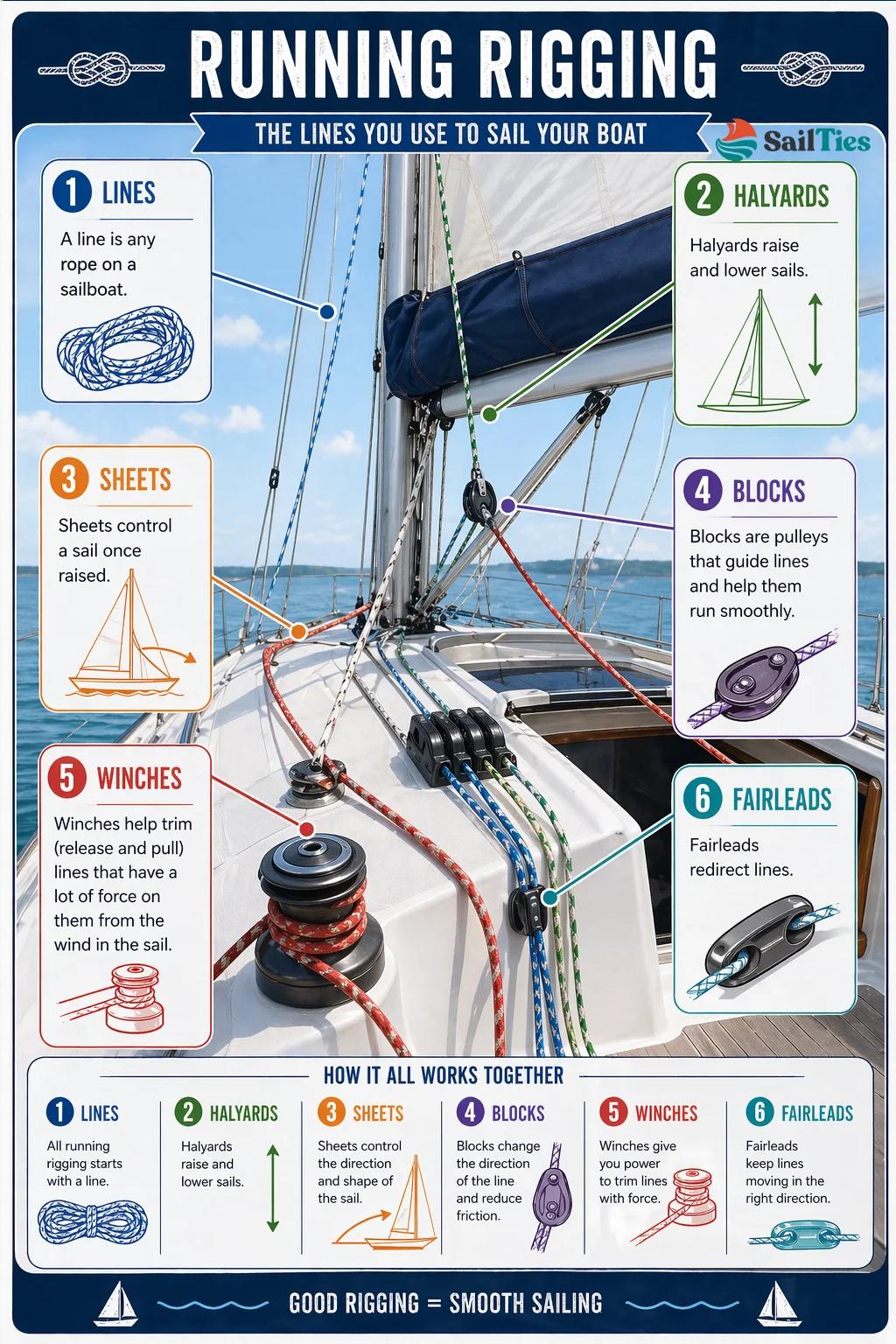
What to study: distinguish halyards from sheets and control lines, then follow each line through every fairlead, block and clutch to its winch and deck attachment. Look for chafe, poor lead angles, overloaded hardware and inaccessible service points. Image/source: SailTies, “Parts of a Sailboat”.
Further learning: Study: Harken technical articles · Watch: Harken winch disassembly and service
Why it matters for an ocean crossing
A parted halyard can make a sail unusable and require a mast climb. A broken reef line in rising wind prevents prompt sail reduction. Chafe can destroy a structurally strong line in hours where it crosses a sharp exit or spreader. Two-handed crews need every lead and clutch to work without leaving the cockpit unnecessarily, plus spare ways to hoist or control sails.
How age changes the answer
The age-band costs below are planning judgements derived from the unit and labor basis in “What it costs,” unless a source is named.
| Age at departure | What is normally justified | Typical cost |
|---|---|---|
| under 5 years | Wash and inspect; replace only glazed, cut, stiff or badly sized lines. | $0–$800 |
| 5–10 years | Condition-led replacement of high-load halyards, furling and reef lines; retain good sheets. | $500–$2,500 |
| 10–15 years | Expect a prioritized refresh if heavily exposed or history unknown. | $1,500–$4,000 |
| over 15 years | Budget most mission-critical lines unless protected and demonstrably sound. | $2,500–$6,000 |
Rope does not have a single age limit. UV exposure, salt crystals, cover abrasion, heat at clutches, overload and usage dominate. A ten-year-old spare stored dry can be better than a three-year-old furling line permanently exposed. Doing nothing is correct when each line is correctly specified, runs freely, has no core/cover damage and its history is credible.
Repair, service or replace
Service means washing salt out, end-for-ending where the working section can be moved, renewing whipping, improving chafe guards and servicing the hardware causing damage. A damaged cover can sometimes be repaired or a halyard shortened if length remains adequate; a parted or heat-damaged load-bearing core means replacement. Replace line by measured diameter, finished length, construction and end termination—not a generic “rope allowance.”
For offshore redundancy, one spare full-length halyard or a topping lift rated to hoist a sail is more useful than replacing every cosmetic line. Professional splices preserve strength and pass through hardware better than knots, but they add labor.
What it costs
| Item | Unit | Bay Area 2026 |
|---|---|---|
| Polyester double braid | per foot | $0.79–$3.19 posted retail range |
| Covered Dyneema performance line | per foot | $2.19–$6.39 typical posted range; sales may be lower |
| 100–140ft cruising halyard | each, material | $250–$750 (judgement) |
| 80–120ft sheet pair | pair, material | $200–$650 (judgement) |
| Reef/furl/control line | each | $80–$300 (judgement) |
| Eye splice/shackle termination | each | $50–$180 (judgement: part plus 0.3–0.8 labor hour) |
| Replace essential set, 36–40ft | boat | $1,500–$3,500 (judgement) |
| Replace broad set, 41–46ft | boat | $3,000–$6,000 (judgement) |
Labor explodes if old halyards are pulled without messenger lines, deck organizers must be removed or clutches do not match the new diameter. Inventory every line and calculate measured length; LOA is a poor proxy for mast height and cockpit routing.
What a pre-purchase survey tells you
- Covered by a standard survey — general condition, obvious chafe, stiffness, poor terminations, operation of furlers/reefing and visible deck hardware. The surveyor rarely measures every line or identifies fiber construction.
- Not covered — core inspection under covers, exact finished lengths, clutch holding tests under sailing load and a full rigging inventory. A separate rigger is normally unnecessary unless the running-rigging defects indicate broader mast/furler problems. A detailed post-purchase inventory is a good owner task and costs nothing.
What to ask
- The broker or owner — “Please list each halyard, sheet, reefing and furling line replaced, with date, diameter, material and invoice.” “Which spare line can hoist the mainsail or headsail if its primary halyard fails?” “Have any lines slipped in clutches or chafed through at mast exits?”
- The surveyor — “Operate every furler and reefing configuration, identify covers worn through to the core, check that clutches hold, and distinguish configuration-specific lines from generic recommendations.”
What you can see yourself
Pull a few feet of every line through your hands. Look for flat or glossy sections, hard spots, melted fibers, an exposed colored core, fuzzy cover at clutches and black or green growth. Bend the line sharply; powder, cracking or a cover that opens indicates degradation. Check knots and splices for movement. Hoist and lower each sail, then reef or furl it. Mark which line does what. If a supposed “reefing line” cannot be found, first determine whether the main is in-mast, in-boom or slab reefed.
Getting the estimate wrong
The classic error is pricing “reefing lines” for an in-mast main. Other traps are counting sheets that come with a new sail twice, assuming all old rope needs replacement, using cheap stretchy polyester for high-load halyards, or specifying thin Dyneema that slips in existing clutches. Do not use boat length as line length; use rig dimensions and routing. Do not add new clutches because lines are old unless the clutches are actually incompatible or worn. Separate spares from installed replacements.
Recommended learning and sources
- Harken technical articles — blocks, furlers, winches and control-system maintenance
- Harken hands-on technical videos — including winch disassembly and service
- Seldén explanation of in-mast furling controls and no fixed reef points
- New England Ropes Sta-Set pricing and properties
- T-900 low-stretch line pricing and applications
- Precision Sails guide to selecting halyards, sheets and lines