What it is
The house battery bank stores energy for domestic and navigation loads; a separate start battery provides high current to crank the diesel. Traditional flooded lead-acid batteries require venting and water. AGM batteries are sealed lead-acid with less maintenance but still lose capacity when repeatedly deeply discharged. Lithium iron phosphate (LiFePO4) provides more usable capacity, less weight and high charge acceptance, but must be protected by a battery-management system (BMS) that monitors cell voltage and temperature and can disconnect unsafe charging or loads.
Amp-hours (Ah) describe charge, not energy by themselves; at 12.8V, 400Ah is about 5.1kWh nominal. Usable energy depends on chemistry and operating limits. A shunt measures current into and out of the bank so a monitor can estimate state of charge. The enclosure, restraints, terminal protection, fuses, busbars, cables and charging sources are part of a safe installation even though their costs sit mostly under electrical.
Owner learning layer
chemistry is only one component
Mental model
The bank is an energy reservoir with limits on voltage, current, temperature and depth of discharge. The charging system must replenish the daily load while every cable, fuse, switch and bus can safely carry worst-case current. A monitor estimates state of charge by counting current and must be synchronized; terminal voltage alone is a weak state-of-charge indicator under load or charge. Calculate an energy budget in watt-hours, then translate it into required generation and realistic usable capacity.
Tradeoffs
Flooded lead-acid is inexpensive and tolerant of simple charging but heavy, vents gas and needs watering. AGM is cleaner and can deliver high current but is sensitive to chronic undercharge and gives less usable energy per pound. LiFePO4 offers high usable capacity and charge acceptance with low weight, but a cell-protective BMS is not a complete system design: chargers, alternator control, disconnect behavior and essential-load continuity must all be engineered. Multiple drop-in batteries may each protect themselves without coordinating a whole-bank failure. Separate start and house banks improve recovery; indiscriminate combining can defeat that separation.
Maintenance competence
Know chemistry, make/model, capacity, age, fuse size, cable size, bank topology and every charging profile. For lead-acid, inspect electrolyte where applicable, state of charge and chronic undercharge. For lithium, understand exactly what opens on high/low voltage or temperature, how the alternator is protected from a sudden disconnect, and how critical navigation loads remain powered. Inspect restraints and terminal covers, keep connections clean and torque only to manufacturer values. Periodically test usable capacity or trend it under a known load; a pretty monitor screen is not a capacity test.
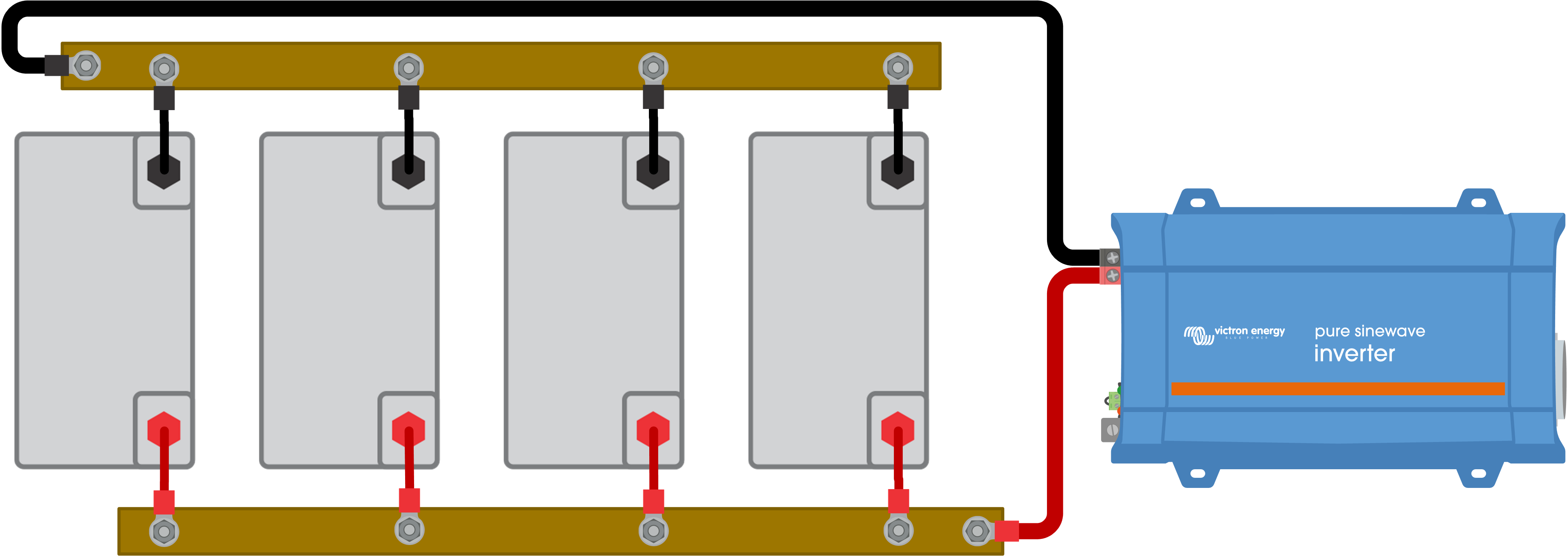
What to study: equal-length interconnects and common busbars make parallel batteries share charge and discharge current more evenly. Compare conductor lengths, fusing and takeoff points aboard; tidy-looking asymmetry can hide chronically unbalanced batteries. Image/source: Victron Energy, “Battery bank wiring”.
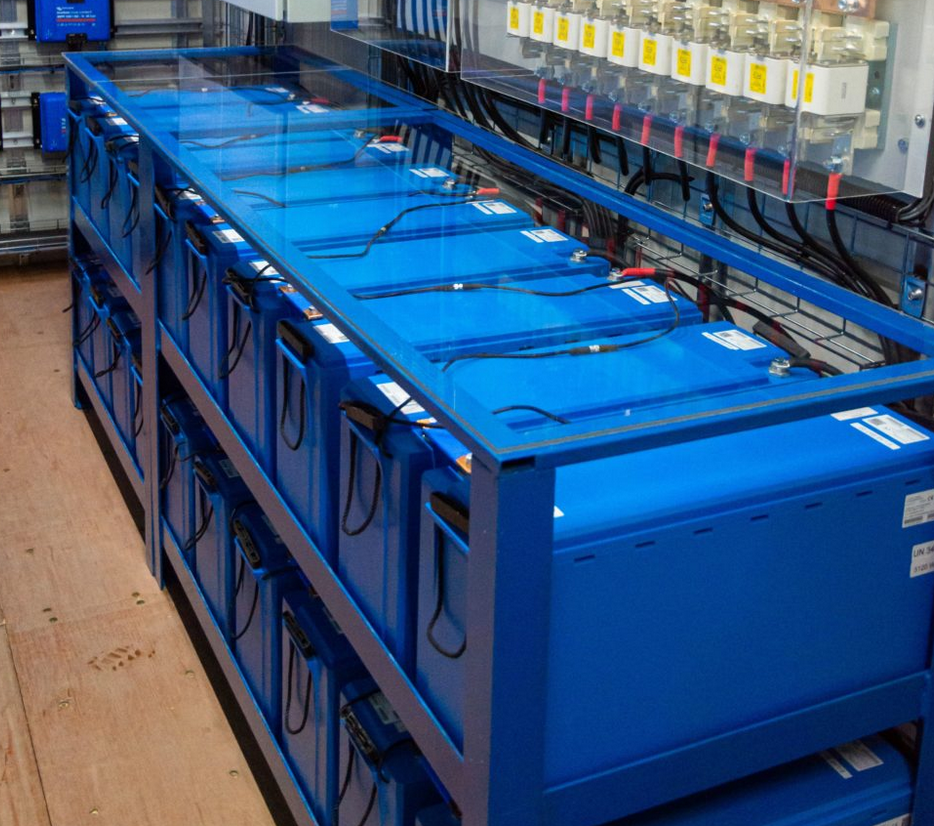
What to study: lithium is a system, not a drop-in box. Identify the cells or batteries, BMS, contactor or protection device, alternator strategy, charge sources, current shunt and the loads that must survive a BMS disconnect. Image/source: Victron Energy, “Wiring Unlimited”.
Further learning: Study: Victron Wiring Unlimited battery-bank guide
Why it matters for an ocean crossing
Loss of the house bank can remove autopilot, AIS, radar, communications, pumps and lights. Excessive voltage drop makes apparently charged batteries unusable. Lithium brings a different failure mode: a BMS may intentionally disconnect the bank, so essential navigation and alternator systems need a planned response. A short across a high-capacity bank releases destructive current. Reliable capacity and redundancy matter more than the advertised Ah number.
How age changes the answer
The age-band costs below are planning judgements derived from the unit and labor basis in “What it costs,” unless a source is named.
| Age at departure | What is normally justified | Typical cost |
|---|---|---|
| under 3 years | Capacity/load test, inspect installation and charging profile; do nothing if healthy. | $0–$500 |
| 3–5 years | Test lead-acid carefully; lithium usually remains serviceable if balanced and documented. | $200–$1,500 |
| 5–8 years | Lead-acid replacement risk rises; lithium remains condition/cycle-led. | $1,000–$6,000 |
| over 8 years | Budget replacement for most lead-acid banks; test lithium rather than replacing by age. | $1,500–$8,000+ |
Lead-acid life varies sharply with depth of discharge, temperature and charging. Lithium age alone is even less informative; cell balance, logged cycles, capacity and BMS history matter. Warranty length is not a mandatory replacement interval. Doing nothing is correct when a controlled capacity test meets the mission requirement, cells are balanced, terminals/restraints are sound and every charge source has the correct profile and disconnect behavior.
Repair, service or replace
Service flooded batteries with water and clean/protect terminals; equalize only when the manufacturer permits. A bad cable or shunt setting can imitate a bad bank. Replace lead-acid cells as a matched bank rather than mixing markedly different ages/capacities. In a modular lithium bank, manufacturer guidance may permit a cell/battery replacement after state-of-charge matching, but first identify why it failed.
Changing AGM to lithium requires an energy design: BMS, main protection, load/charge contactors or compatible integrated BMS, alternator current/temperature control, shore/solar programming and a start-bank strategy. Drop-in lithium can be appropriate, but “drop-in” does not mean the old alternator and charger are automatically safe.
What it costs
| Item | Unit | Bay Area 2026 |
|---|---|---|
| Lead-acid capacity/load test | bank | $300–$800 (judgement) |
| Group 31 AGM, roughly 100Ah | each | $350–$600 (judgement) |
| 400Ah AGM house bank | batteries only | $1,400–$2,400 (judgement) |
| Battle Born 270Ah LiFePO4 | each | $2,299 posted sale; $2,649 regular |
| 400–600Ah quality LiFePO4 cells/batteries | batteries only | $3,500–$7,000 (judgement) |
| BMS/shunt/contactors/main protection | parts | $1,000–$3,500 (judgement) |
| Lithium conversion, excluding solar | installed | $7,000–$15,000 (judgement) |
| Start battery | installed | $400–$900 (judgement) |
The posted battery price is not the conversion price. A bank already installed with correct BMS, fusing, alternator protection and charge profiles should not be costed again merely because the model prefers lithium. Conversely, four lithium cases beside an automotive combiner are not proof of a complete system.
What a pre-purchase survey tells you
- Covered by a standard survey — chemistry, approximate age from labels/invoices, voltage, visible cases/terminals, restraints, venting, main switches and basic charging voltage. Some surveyors apply a short load but not a full capacity test.
- Not covered — 20-hour capacity testing, per-cell lithium data, BMS event logs, alternator heat/load behavior and detailed charge programming. A marine-electrician capacity/system test ($500–$1,500) is worthwhile before purchase when the bank is a material part of the price, lithium integration is unclear or endurance claims drive the cruising plan.
What to ask
- The broker or owner — “Send purchase invoices and exact model/serial for every battery, BMS, shunt and charger.” “Provide the current BMS settings/event history and a recent controlled capacity test.” “Show how charge and load disconnects work, how the alternator is protected, and how the engine starts after a house-bank shutdown.”
- The surveyor — “Identify actual chemistry/capacity, inspect restraint and terminal protection, record resting and charging voltage, and flag whether the installation needs an electrician-led lithium audit rather than assuming the labeled Ah is usable.”
What you can see yourself
Check case dates and invoice dates. Look for swelling, cracks, acid, corrosion, loose restraints and exposed positive terminals. With a monitor, compare current against known loads and see whether state of charge behaves plausibly. Start the engine and switch on inverter/other heavy loads while watching voltage. For lithium, connect to the manufacturer app if authorized and record cell-voltage spread, temperatures and alarms. A pristine display does not prove capacity; only a measured discharge test does.
Getting the estimate wrong
Do not replace a young healthy bank to meet an arbitrary age rule. Do not compare 400Ah AGM and 400Ah lithium as equal usable energy. Avoid counting batteries here and again inside an “electrical refit.” Do not cost a new alternator automatically with lithium; first identify existing alternator, regulator and protection. Do not accept “400Ah lithium installed” without BMS, charge-source and fuse details. A cheap cell price omits safe enclosure, compression where specified, busbars, controls and commissioning.