What it is
The steering system connects helm input to the rudder. A tiller clamps directly to the rudder stock. A common wheel system uses a sprocket and stainless chain inside the pedestal, wire cables running over sheaves (pulleys), and a quadrant or radial wheel attached to the rudder stock. Other boats use geared linkage, push-pull conduit or hydraulics. The quadrant is the large partial wheel on the stock; an idler turns the cable path below the pedestal. A key or clamp prevents the quadrant from slipping on the stock.
An emergency tiller fits directly to the rudder stock if wheel linkage fails. The autopilot drive normally acts through a separate tiller arm; that arm is not a substitute for the main quadrant unless engineered as one.
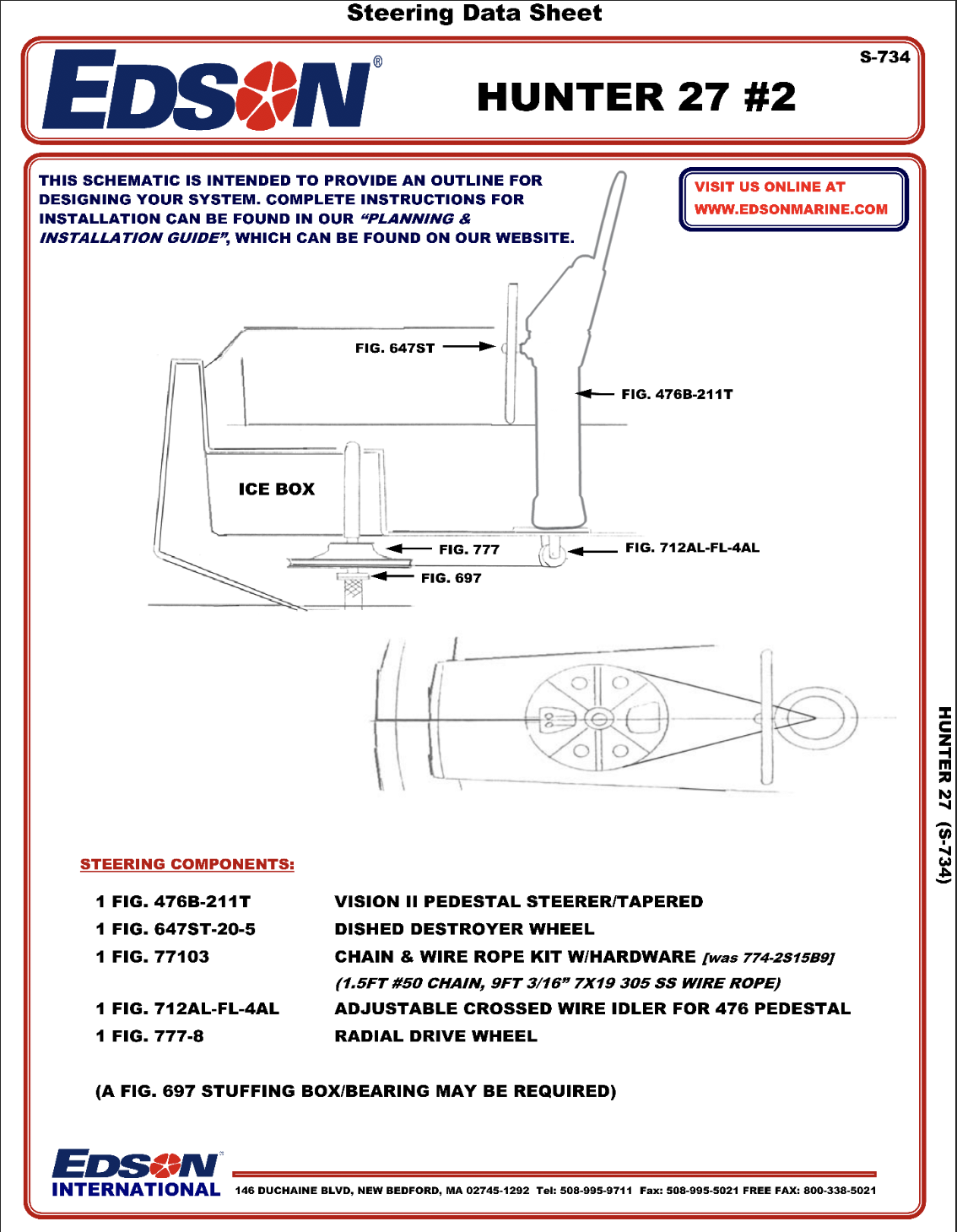
What to study: this representative Edson data sheet shows the wheel/pedestal, chain-and-wire run, crossed idler and radial drive on the rudder stock. The target yacht may use a quadrant, rack-and-pinion or hydraulic system, so obtain its own drawing and verify cable tension, sheave alignment, stops, fasteners and emergency-tiller access. Image/source: Edson sailboat steering data sheets.
Further learning: Study: Edson steering inspection and maintenance library · Watch: Edson chain-and-wire steering videos
Why it matters for an ocean crossing
Steering loss can make the boat uncontrollable in breaking seas or near land. Cable jumping a sheave, chain corrosion, a loose quadrant or failed pedestal bearing can occur with little warning if hidden. Friction and play also burden the autopilot, increasing power use and drive wear. The crew must be able to isolate a jam and deploy the emergency tiller at sea, not merely confirm it exists in a locker.
How age changes the answer
The age-band costs below are planning judgements derived from the unit and labor basis in “What it costs,” unless a source is named.
| Age at departure | What is normally justified | Typical cost |
|---|---|---|
| under 10 years | Annual inspection, lubrication and cable-tension check; normally do nothing. | $0–$600 |
| 10–20 years | Inspect chain, cable, sheaves, pins, pedestal and quadrant closely; replace worn parts only. | $500–$3,000 |
| 20–30 years | A preventive chain/cable refresh may be prudent when original or inaccessible. | $1,500–$5,000 |
| over 30 years | Budget broader overhaul if original, corroded or loose; age alone still does not require a new pedestal. | $2,500–$10,000+ |
Edson calls for regular inspection and highlights slack cable as a cause of derailment. Stainless cable life depends on bends, tension, salt and hidden water. A 25-year-old dry, smooth system with documented cable renewal may need only service; a newer system with broken strands must be replaced immediately.
Repair, service or replace
Service includes cleaning/lubricating the chain as specified, checking cable tension, cotters, sheave alignment, bearings and quadrant fasteners. Correct too much slack, but do not overtighten and overload bearings. Replace individual sheaves/pins, pedestal bushings, chain-and-wire assembly or brake parts as condition requires.
Wholesale steering replacement is rare unless converting type, repairing structural damage or facing obsolete/corroded machinery. Hydraulic leaks may need hose/seal or cylinder work, not a new helm. Always prove the emergency tiller can be installed with cockpit gear and berth contents in place; modify access or tiller geometry if it cannot actually steer.
What it costs
| Item | Unit | Bay Area 2026 |
|---|---|---|
| Annual inspection/tension/lube | job | $300–$800 (judgement) |
| Edson chain and wire assembly | part | from about $344 posted |
| Chain/cable replacement | installed | $1,200–$3,000 (judgement) |
| Idler/sheave assembly | part | roughly $300–$1,025 posted, type dependent |
| Pedestal bearing/brake service | job | $800–$2,500 (judgement) |
| Custom autopilot tiller arm | part | $684–$887 posted |
| Emergency tiller fabrication/modification | job | $800–$3,000 (judgement) |
| Broad wheel-steering overhaul | job | $3,000–$8,000 (judgement) |
Access is the main variable. Two hours on an exposed quadrant and two days dismantling an aft berth are different jobs. Keep rudder-bearing work in the rudder section and autopilot drive work in autopilot, even though either can create helm friction.
What a pre-purchase survey tells you
- Covered by a standard survey — helm play/friction, visible pedestal, chain/cable/quadrant where accessible, hydraulic leaks, stops, fasteners and existence of emergency steering. The sea trial reveals load behavior.
- Not covered — full cable removal, pedestal teardown, internal hydraulic-cylinder testing and realistic emergency-tiller trial under sail. A separate steering specialist is usually unnecessary unless there is play, noise, corrosion, leakage or a complex obsolete system. One to three skilled hours ($300–$800) can resolve scope before purchase.
What to ask
- The broker or owner — “Send invoices and dates for steering cable/chain, sheaves, bearings, quadrant, pedestal and hydraulic work.” “When was the emergency tiller last installed and used?” “Has a cable ever jumped, the helm jammed or the quadrant slipped?”
- The surveyor — “Open steering access, inspect the complete visible cable path and terminations, check quadrant key/clamp and stops, isolate autopilot friction if needed, and physically fit the emergency tiller.”
What you can see yourself
Move the wheel slowly lock to lock with the autopilot disconnected. Feel for tight spots, grinding and unequal effort. Have someone watch the quadrant while you reverse direction: wheel motion before rudder motion reveals play. Inspect cables for broken strands, meat hooks, rust and flat spots, especially where they bend over sheaves. Check cotter pins, loose mounting plates and cable alignment. Tug the quadrant. Then retrieve and install the emergency tiller; if cushions, a table or deck plate make this unrealistic, the system is not ready.
Getting the estimate wrong
Do not blame steering friction on the pedestal until the autopilot ram and rudder bearings are isolated. Do not replace the entire system for modest cable slack. Conversely, do not dismiss one broken wire strand. Avoid pricing an autopilot tiller arm twice. Existence of an emergency tiller is not evidence it works. Keep rudder bearing, steering linkage and autopilot drive as three related but distinct cost lines.
Recommended learning and sources
- Edson steering support library — inspection checklist, planning guide and maintenance manuals
- Edson steering videos — visual explanation of chain-and-wire components and service
- Edson passage-preparation steering guidance
- Edson steering troubleshooting and isolation method
- Edson cable-tension inspection guidance
- Edson chain-and-wire pricing
- Edson service parts and tiller-arm pricing