What it is
Navigation electronics commonly include a multifunction display/chartplotter, GNSS/GPS antenna, depth/speed/wind instruments, magnetic heading sensor, radar, AIS transceiver, fixed VHF with DSC, handheld VHF and data network. AIS broadcasts vessel identity/position and receives equipped targets; Class B SOTDMA units typically transmit at higher power/update priority than older CSTDMA units. AIS does not show untransmitting boats, debris or land.
Modern solid-state pulse-compression radar can show rain, land and non-AIS targets; Doppler/moving-target coloring helps distinguish approaching from receding targets but does not identify everything automatically. NMEA 2000 is a shared instrument network; NMEA 0183 is older point-to-point serial data. Starlink is communications, not a navigation or collision-avoidance sensor, and service legality/coverage can change by country and plan.
Owner learning layer
sensors, networks and human judgement
Mental model
Sensors observe imperfectly; networks transport data; displays interpret it; alarms demand attention; the navigator decides. A chartplotter position can be accurate while the charted hazard is wrong. AIS provides cooperative target data; radar provides reflected energy; visual and depth information add independent evidence. Trace where position, heading, speed, wind and depth originate and which functions fail when one sensor or network backbone loses power.
Tradeoffs
One integrated ecosystem can simplify configuration and support but creates common-mode dependence. Mixed brands may choose best-in-class parts but complicate gateways and troubleshooting. Mast-mounted radar sees farther but adds cable/rig weight and may be shaded or damaged; lower mounting eases service. Broadband connectivity enables weather and support but has high energy/data-plan dependence. Tablet navigation is excellent redundancy if charts, charging and waterproofing are independent. Duplicate displays on one breaker and one GPS are not true redundancy.
Maintenance competence
Learn radar range/gain/rain/sea controls and practice on known targets in daylight; automatic modes are a starting point. Configure AIS identity accurately and verify transmission externally. Test DSC with the correct non-distress method, update charts and software deliberately, back up configurations, inspect connectors/terminators and label network drops. Maintain paper or offline navigation and independent position capability appropriate to the voyage. Treat alarms as engineered workflows: set thresholds, understand nuisance sources and confirm that sound/light reaches a sleeping or working crew.
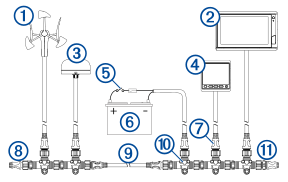
What to study: NMEA 2000 is a powered linear backbone with exactly two terminators and short spurs to devices—not an arbitrary daisy chain. Identify the power insertion point, backbone route, terminators, drop cables, gateways and which display or sensor becomes a single point of failure. Image/source: Garmin, “NMEA 2000 Network Components”.
Further learning: Study: Garmin marine support and radar resources · Watch: Garmin marine-radar tutorial
Why it matters for an ocean crossing
Radar, AIS, depth and reliable charts reduce—but do not remove—collision and grounding risk. VHF/DSC carries distress and local traffic. A correct heading source is essential for radar overlay and autopilot performance. Integration faults can create confident but wrong displays. Offshore resilience requires independent position/chart and communications paths, not two screens fed by one failed GPS/network.
How age changes the answer
The age-band costs below are planning judgements derived from the unit and labor basis in “What it costs,” unless a source is named.
| Age at departure | What is normally justified | Typical cost |
|---|---|---|
| under 7 years | Update software/charts, inspect antennas/network and test; often do nothing. | $0–$1,000 |
| 7–12 years | Replace failed/unsupported components selectively; check radar magnetron if applicable. | $1,000–$6,000 |
| 12–20 years | Network/compatibility and display support may justify a staged suite refresh. | $3,000–$15,000 |
| over 20 years | Treat legacy suite value cautiously; retain working independent instruments where useful. | $5,000–$25,000+ |
Electronics do not become inaccurate simply from age, but displays, connectors, internal batteries, radar transmitters and charts age, while product/network support ends. A supported ten-year-old suite with clean data can be retained. Doing nothing is correct when every sensor is calibrated, AIS transmission verified externally, radar tested on real targets, charts current and independent backups exist.
Repair, service or replace
Start by cleaning power/network faults, updating software and calibrating heading, depth offsets, speed and wind. Replace corroded connectors/antennas or one failed display when compatible. A VHF antenna/coax problem may degrade AIS and radio together. Verify the AIS MMSI cannot require factory/dealer reset before ownership transfer.
Replace a whole ecosystem only when network incompatibility, support and desired sensor integration make partial work uneconomic. Choose one primary ecosystem for radar/chartplotter/autopilot compatibility, but preserve independent GPS/tablet/handheld VHF. Add Starlink with waterproof mounting, 12V conversion or inverter load and a current service plan; do not rely on it for distress.
What it costs
| Item | Unit | Bay Area 2026 |
|---|---|---|
| B&G Zeus S 9 chartplotter | part | $1,499 posted |
| B&G HALO20+ radar | part | $2,499 posted |
| Garmin Fantom 18x radar | part | $2,299.99 posted |
| Garmin AIS 800 | part | $1,099.99 list; about $860–$900 street |
| Fixed VHF/antenna/coax | installed | $1,000–$2,500 (judgement) |
| Wind/depth/speed package | installed | $2,500–$6,000 (judgement) |
| Radar plus mount/cable/commissioning | installed | $4,000–$7,000 (judgement) |
| MFD/AIS/radar/instruments partial suite | installed | $10,000–$20,000 (judgement) |
| Broad suite, 36–46ft | installed | $18,000–$35,000+ (judgement) |
Installation often equals hardware because of mast cable runs, radar bracket, NMEA backbone, electrical protection, transducers and configuration. Starlink hardware/service should be priced at purchase because plans change; Starlink currently lists US Roam service at $55/100GB, $80/300GB and $175/unlimited monthly, but offshore/international use must be verified for the intended 2028 itinerary.
What a pre-purchase survey tells you
- Covered by a standard survey — power-on/function of displays, depth/speed/wind, VHF basic radio check, radar/AIS presentation and visible installation. A surveyor may not verify AIS over an external receiver or calibrate sensors.
- Not covered — network packet/termination analysis, RF power/SWR, AIS programming, radar performance calibration, transducer extraction, subscription/coverage validation and software-support roadmap. An NMEA electronics technician ($700–$2,000) is valuable before purchase for an expensive claimed-integrated suite, intermittent faults, mixed brands/generations or failed radar/AIS.
What to ask
- The broker or owner — “Send model/serial/software version and invoice for every display, sensor, radar, AIS, VHF and network component.” “Provide the NMEA diagram and MMSI/registration details.” “Which functions are intermittent or unsupported, and when were charts last updated?”
- The surveyor — “Verify sensor values against independent references, check AIS transmission on another receiver/service, test VHF/DSC and radar on known targets at short and medium range, inspect network power/terminators, and identify shared single points of failure.”
What you can see yourself
Cold-boot the entire suite and note errors. Compare heading with a hand compass, position with a phone/tablet, depth with chart/tide and wind direction with a masthead visual reference. Find your AIS target on another vessel or qualified receiver. Call a radio-check service at low then appropriate power. Run radar while tied up and identify docks, buoys, rain and moving boats; check bearing alignment. Wiggle—not disconnect—suspect plugs and watch for resets.
Getting the estimate wrong
Do not replace a whole suite because one display is old. Conversely, do not value powered screens without testing sensors and transmission. AIS and radar complement rather than duplicate each other. A radar dome price is not installed cost. Avoid counting the autopilot computer in both systems. Do not assume “Doppler radar” provides autonomous watchkeeping or detects small low objects reliably. Starlink plan/coverage today is not a guaranteed 2028 offshore entitlement.
Recommended learning and sources
- Raymarine online guides — radar, AIS, sailing displays, calibration and autopilot workflows
- B&G HALO20+ current US specifications and price
- B&G Zeus S 9 current retail price
- Garmin Fantom 18x current retail price
- Garmin AIS 800 manufacturer description
- Garmin AIS 800 current retail/list price
- Starlink current US service plans