What it is
Safety equipment combines personal gear, distress communications, fire/flood response and abandon-ship equipment. For this voyage it includes properly fitted inflatable lifejackets with integrated harness/crotch strap, tethers, jacklines, recovery gear, EPIRB registered to the vessel, personal locator/AIS beacons, VHF/DSC, flares or approved electronic signals, fire extinguishers, smoke/CO alarms, medical kit, damage-control plugs/materials and an offshore liferaft. A grab bag holds items needed after abandoning.
US Coast Guard carriage rules are a legal floor, not a bluewater equipment design. The World Sailing Offshore Special Regulations (OSR) provide a useful structured offshore benchmark even for non-racers. Product approvals, service dates and vessel/owner registration matter as much as physical presence.
Owner learning layer
layered survival, not a shopping list
Mental model
Build safety in layers: prevent the event; keep people aboard; detect fire/flooding/collision; contain damage; communicate; recover a person; and abandon only when the boat is no longer the safer place. Equipment is useful only if reachable, registered, compatible and practiced. Map likely emergencies to a first action, isolation point, alarm, communication device and backup.
Tradeoffs
Inflatable lifejackets are wearable and comfortable but require cylinder, inflator and bladder inspection; foam is simple but bulky. AIS personal beacons can alert the boat and nearby vessels quickly but are not the same as a satellite PLB. A vessel EPIRB identifies the boat; PLBs identify people. A canister raft may deploy readily on deck but is exposed; a valise can be protected below yet inaccessible after rapid flooding. More gear can create false confidence and maintenance load. The best setup minimizes the time between incident and correct action.
Maintenance competence
Maintain a register of serials, registrations, batteries, hydrostatic releases, inspection/service and expiry dates. Fit lifejackets to actual crew and inspect arming indicators, cylinders, bladder and crotch straps per maker instructions. Practice clipping in, emergency steering, MOB recovery, extinguishing a simulated fire, isolating batteries/fuel/gas, plugging a leak, sending DSC distress and launching/accessing the raft without improvisation. Put critical gear where it survives the casualty it is meant to address. A sealed raft with an in-date sticker is not evidence that the crew can reach or board it.
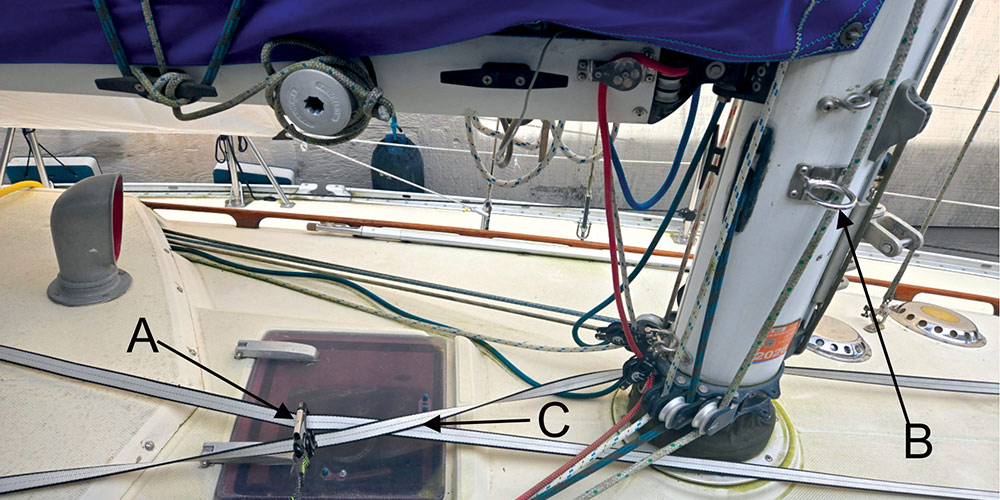
What to study: the purpose of a tether is to keep a person on the boat, not merely attached while being dragged alongside. Evaluate jackline location, strong points, transitions, clipping before leaving the companionway and whether a short tether can prevent reaching the rail. Image/source: 48° North, “Understanding Your Boat’s Safety Gear”.

What to study: abandoning into a raft is an operational system—accessible stowage, a correctly secured painter and hydrostatic release where used, launching, boarding aids, grab lines, canopy, equipment pack, servicing and crew practice all matter. U.S. Air Force photo by Master Sgt. Val Gempis, Wikimedia Commons, public domain in the United States.
Further learning: Study: World Sailing Offshore Special Regulations · Watch: ACR ResQLink AIS lifejacket installation
Why it matters for an ocean crossing
This equipment is used after prevention has failed. A lifejacket without crotch strap or light, an unregistered EPIRB, expired raft, inaccessible extinguisher or tether that lets crew go over the rail can turn a recoverable event fatal. Two-handed sailing makes man-overboard prevention especially important: the remaining person may be asleep, below or unable to turn quickly.
How age changes the answer
The age-band costs below are planning judgements derived from the unit and labor basis in “What it costs,” unless a source is named.
| Age/service status at departure | What is normally justified | Typical cost |
|---|---|---|
| In date and documented | Inspect, register, drill and replace consumables only; do nothing otherwise. | $0–$1,000 |
| Due within voyage | Service before departure or budget replacement where service is uneconomic. | $500–$3,000 |
| Expired/unknown | Treat as not mission-ready until manufacturer-authorized service proves it. | $1,000–$6,000 |
| Obsolete/unserviceable | Replace with current approved gear matched to crew and route. | $3,000–$10,000+ |
Safety gear is governed by individual service/expiry rules, not boat age. Liferaft service interval varies by make/configuration—Switlik advertises five-year intervals on several rafts, while other brands specify three years or staged intervals. Beacon batteries, pyrotechnics, inflatable-PFD cylinders/bobbins and extinguishers have their own dates. Doing nothing is correct only when approval, fit, registration, service date and accessibility all check out.
Repair, service or replace
Use authorized service for liferafts and beacons. PFDs can be owner-inspected/inflated according to manufacturer guidance, with dated cylinder/activation parts changed as required. Repack medical supplies by actual expiry and voyage needs. Service or replace extinguishers by type/inspection status. Add AIS MOB/PLBs to worn PFDs only if mounting and antenna deployment remain correct.
Hardware alone is inadequate. Drill PFD inflation in water, tether/jackline movement, MOB recovery, fire response, flooding plugs, Mayday/DSC/EPIRB procedure and raft launch. The best cost may be two excellent worn-always PFD/harnesses rather than numerous uncomfortable spares, while still carrying legal guest flotation.
What it costs
| Item | Unit | Bay Area 2026 |
|---|---|---|
| Spinlock Deckvest 6D offshore PFD/harness | each | about $379–$469 posted |
| ACR GlobalFix V6 EPIRB | each | $744.95–$854.95 posted |
| ACR ResQLink AIS PLB | each | $619.95 posted |
| ISO 9650-1 4–6 person offshore raft | each | about $2,075–$3,700 posted range |
| Liferaft service | event | $800–$2,000 (judgement: maker/station/pack) |
| Tethers and jacklines for two | set | $500–$1,200 (judgement) |
| Flares/signals/fire/medical/damage control | package | $1,000–$3,000 (judgement) |
| Two-person offshore package from weak baseline | boat | $6,000–$12,000 (judgement) |
Do not assign resale value to expired gear without a service quote. Raft freight/service and hazardous pyrotechnic shipping vary. OSR compliance can add storm gear and training outside this portable-equipment line.
What a pre-purchase survey tells you
- Covered by a standard survey — inventory, visible approval/expiry/service labels, legal carriage items, mounting/access and often fire extinguisher status. A surveyor does not certify raft contents or inflate PFDs.
- Not covered — authorized raft/beacon/PFD service, medical-content validation, crew fit, jackline engineering and operational drills. Obtain raft service history/quote before valuing it. Specialist service cost is product-specific; for unknown/expired gear, value it at zero in the offer unless a service station confirms otherwise.
What to ask
- The broker or owner — “Send photos of model/serial, approval and expiry/service labels for raft, EPIRB, PFDs, beacons, extinguishers and flares.” “Send authorized service invoices and confirm EPIRB deregistration/transfer process.” “Which gear is physically aboard and included in sale?”
- The surveyor — “Inventory by serial/date and distinguish legal minimum from offshore readiness; inspect jackline attachment/recovery arrangement and access to raft, EPIRB, extinguishers and plugs; do not assign serviceability to sealed gear without records.”
What you can see yourself
Photograph every date/serial label. Put on each primary PFD and tether: it must fit with foul-weather clothing. Trace jacklines and check whether the short leg prevents going over the rail. Lift the raft to learn whether two people can deploy it and whether inversion traps it. Confirm the EPIRB self-test status without activating distress. Shake/inspect extinguishers as specified and find plugs beside through-hulls. If gear is buried, it is not accessible.
Getting the estimate wrong
Do not treat USCG minimum gear as an ocean package. Do not count an expired raft at new replacement value or assume every expired raft must be discarded without a service quote. Avoid duplicating VHF/AIS under electronics and safety; keep installed communications in electronics, portable distress beacons here. Equipment count is not readiness: registration, fit, expiry, mounting and drills decide usefulness. Do not buy for an imagined six-person crew when the operating case is two without separately identifying guest requirements.
Recommended learning and sources
- World Sailing Offshore Special Regulations 2026–2027
- US Coast Guard federal recreational equipment guide and FAQ
- ACR GlobalFix V6 current price
- ACR ResQLink AIS PLB current price
- Spinlock Deckvest 6D specifications/pricing
- Revere ISO offshore raft current pricing example
- Datrex Liberty ISO 9650-1 raft current pricing example