What it is
The auxiliary engine is normally a 30–60hp freshwater-cooled diesel. The closed loop circulates coolant through the engine and a heat exchanger; a separate raw-water pump draws seawater through a seacock and strainer, pushes it through the exchanger, then injects it into the exhaust. A rubber impeller inside that pump is a routine service part. The exhaust mixing elbow is where cooling water enters hot exhaust gas and is a corrosion/carbon trouble point. Engine mounts isolate vibration and hold alignment. Belts drive the alternator and sometimes the coolant pump. The starter, alternator, control panel, throttle/shift cables and stop system complete the installation.
Hours are useful only with records. A neglected 600-hour engine can be worse than a maintained 5,000-hour engine. “Rebuild” should mean documented machining, measurements and replaced internal parts, not paint and new external seals.
Owner learning layer
four things a diesel needs
Mental model
A diesel needs clean fuel, clean air, compression and cooling; it then needs lubrication and an exhaust path to survive. Trace the two cooling circuits separately: coolant circulates inside the engine, while raw seawater enters through a seacock and strainer, passes the pump/impeller and heat exchanger, and exits with exhaust. Trace fuel from tank to primary filter, lift pump, secondary filter and injection system, including the return. Finally trace mechanical output through mounts, transmission and coupling. Most “engine problems” are failures in these supporting paths, not broken internal metal.
Tradeoffs
Older mechanically injected engines are often understandable and repairable with basic tools but may be smoky, heavy and parts-constrained. Newer common-rail engines are quieter, cleaner and more efficient but add high-pressure components, sensors and diagnostic dependence. More horsepower is not automatically better: propeller, cooling, access, weight and the ability to reach loaded cruising RPM matter. A large alternator adds charging capability but increases belt load and heat. Good service access is a first-order feature; a cheap engine hidden behind immovable joinery is expensive ownership.
Maintenance competence
You should be able to perform daily checks, shut off fuel and raw water, change both fuel filters, bleed the low-pressure fuel side where the model permits, replace the raw-water impeller and belt, clean the strainer, identify coolant and oil specifications, and recognize abnormal smoke, temperature, pressure, vibration or exhaust flow. Keep model-specific spares and the actual manual. Track both calendar and hours. Never crank a non-starting engine indefinitely with the raw-water seacock open: water can accumulate in the exhaust and enter cylinders. Know when to stop diagnosing and preserve evidence for a mechanic.
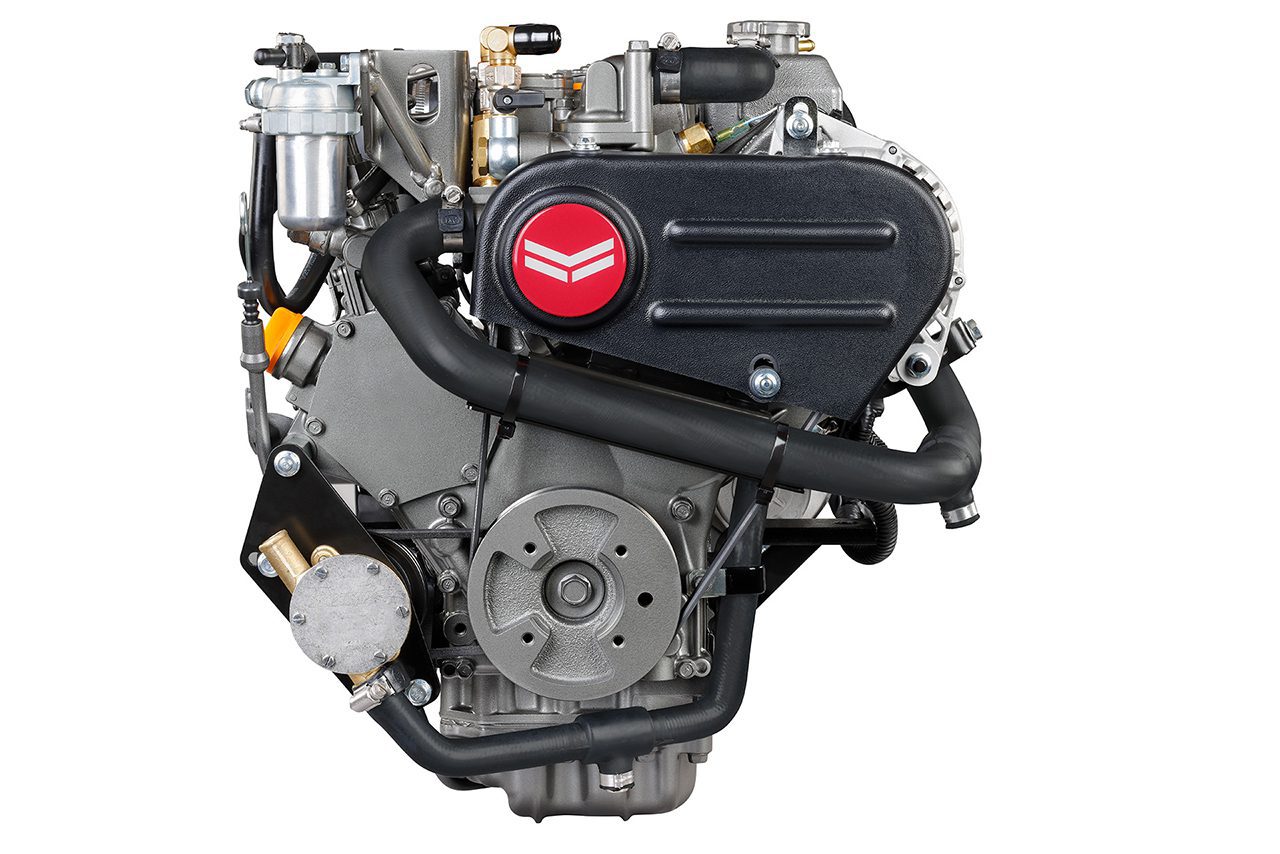
What to study: locate the dipstick, oil fill, filters, belts, alternator, starter, raw-water pump, heat exchanger, exhaust elbow, gearbox and engine mounts on the actual installation—and judge whether a human can reach them without dismantling the boat. Image/source: Yanmar 3YM30AE.

What to study: a typical wet-exhaust installation needs adequate fall from the injection elbow to the waterlock, a siphon break where required and an outlet loop above the heeled waterline. Compare this representative drawing with the exact engine and exhaust manual aboard. Image/source: Beta Marine USA, “Installation Basics”.
Further learning: Study: Yanmar JH operation manual and downloads
Why it matters for an ocean crossing
The engine is needed for harbor maneuvers, charging, making water on some boats and propulsion during calms or emergencies. Cooling loss can destroy it in minutes. Fuel, exhaust or electrical faults can cause fire, flooding or carbon monoxide. A failure on the ocean is inconvenient; a failure approaching a reef pass or lee shore is immediately dangerous.
How age changes the answer
The age-band costs below are planning judgements derived from the unit and labor basis in “What it costs,” unless a source is named.
| Age at departure | What is normally justified | Typical cost |
|---|---|---|
| under 10 years | Verify scheduled service, cold start and load test; do nothing if clean and documented. | $0–$2,500 |
| 10–20 years | Baseline service; inspect elbow, mounts, cooling system, hoses and valve schedule. Compression/oil analysis only if evidence calls for it. | $1,000–$6,000 |
| 20–30 years | Condition and parts support dominate; budget deferred peripherals, not automatic repower. | $2,000–$12,000 |
| over 30 years | Repower becomes a credible risk allowance if corrosion, low compression, poor parts access or chronic faults exist. | $5,000–$15,000 repair; $25,000–$45,000+ repower |
Diesel blocks often outlast cooling, exhaust, mounts and wiring. Age alone does not justify an engine replacement. A correct cold start, full-power sea trial, stable temperature, normal oil pressure, clean fluids and strong records can support doing nothing beyond scheduled service. A surveyor or insurer may request an engine specialist because the normal hull survey excludes internal condition; that is a scope issue, not an age-based condemnation.
Repair, service or replace
A baseline service changes oil and filters, fuel filters, impeller and belts as due; checks coolant, valve clearance schedule, zincs, hoses, clamps, raw-water flow and leaks; and records RPM/temperature under load. Repair the actual fault: starter, alternator, heat exchanger, elbow, injector, mount or pump. Compression testing, oil analysis and injector testing are diagnostics, not ritual replacements.
A top-end job addresses head/valves; a true rebuild addresses wear inside the block. Repower is justified by a damaged block, uneconomic rebuild, obsolete parts, repeated unreliability or a badly mismatched engine—not faded paint. It usually triggers mounts, beds, exhaust, controls, wiring, shaft/coupling or saildrive interface work.
What it costs
| Item | Unit | Bay Area 2026 |
|---|---|---|
| Mechanic labor | hour | $140–$190 planning band |
| Oil/filter/impeller baseline service | job | $900–$2,000 (judgement: parts plus 4–8 hours) |
| Cooling-system/heat-exchanger service | job | $1,000–$3,000 (judgement) |
| Exhaust mixing elbow | installed | $900–$2,500 (judgement) |
| Four engine mounts and alignment | job | $1,500–$4,000 (judgement) |
| Starter or stock alternator | installed | $1,000–$3,000 (judgement) |
| Injector service | set | $1,000–$2,500 (judgement) |
| Engine specialist pre-purchase inspection | visit/sea trial | $800–$2,000 (judgement) |
| Rebuild, 30–60hp | job | $15,000–$30,000 (judgement; removal/access vary) |
| Repower, 30–60hp | installed | $25,000–$45,000+ (judgement) |
Beta notes a complete rebuild can be within $1,000–$2,000 of a new engine before the boat-specific installation question is resolved. The engine crate is therefore not the repower total. Common omissions are removal crane, cutting/rebuilding access, transmission, shaft/prop changes, exhaust, controls, panel, alternator integration, alignment and sea trial.
What a pre-purchase survey tells you
- Covered by a standard survey — external condition, fluids, leaks, mounts, hoses, belts, exhaust, controls, cold start if arranged and observed operation/sea-trial RPM. Many survey reports expressly disclaim internal machinery condition.
- Not covered — compression/leak-down, injector testing, oil/coolant laboratory analysis, heat-exchanger disassembly, ECU diagnostics and expert valuation of a rebuild. An engine survey at roughly $800–$2,000 is worthwhile before purchase when the engine is high-value, starts poorly, smokes, overheats, cannot reach rated RPM, lacks records or makes abnormal metal/noise. Insist the seller not warm it before arrival.
What to ask
- The broker or owner — “Please leave the engine stone cold for inspection and send a clear photo of the model/serial plate and current hour meter.” “Send invoices for oil/filter, impeller, coolant, valve clearance, heat exchanger, exhaust elbow, injectors, mounts and any rebuild.” “Has it ever overheated, ingested seawater, lost oil pressure or failed to reach rated RPM?”
- The surveyor — “Record block temperature before start; video the cold start; note cranking time, smoke and discharge water; run at wide-open throttle long enough to stabilize; compare achieved RPM with the manufacturer rating; and recommend specialist tests only from observed evidence.”
What you can see yourself
Touch the block before anyone starts it. It should be ambient temperature. Watch the exhaust at start: a brief puff differs from continuous white steam, blue oil smoke or heavy black smoke. Check raw-water discharge. Run from idle to full load and record RPM, temperature and vibration. Pull the dipstick before and after: gray/milky oil, metal glitter, rising level or burnt smell is bad. Open the coolant cap only when cold and look for oil, rust or low level. Inspect beneath the engine with a white towel. Squeeze cold hoses, inspect belt dust, rusty mounts, leaking pump weep holes and soot/water around the elbow.
Getting the estimate wrong
Do not repower from age or hours alone, and do not describe ordinary filters and impellers as a “rebuild.” Avoid double-counting alternator work in engine and electrical; assign the alternator/regulator and lithium protection to electrical unless replacing like-for-like. A compression test is not automatically required on every boat, while a warmed engine is not a valid cold start. Do not price a new engine without installation. Do not assume “Volvo D2-55” identifies the exact variant—suffix, serial and transmission matter for parts.