What it is
Deck hatches provide light, ventilation and escape through a framed acrylic lid. Portlights are smaller hull or cabin-side windows, opening or fixed. Larger fixed windows may be bonded acrylic/polycarbonate or framed glass. Seals include glazing adhesive between lens and frame, frame-to-deck bedding, opening gaskets and handle/O-ring seals. A leak's path may travel far from the visible drip.
Lewmar stamps post-1997 acrylic with identification information; model, size and production generation matter because gaskets, lenses and complete units are not interchangeable. Acrylic crazing is a network of fine surface cracks; deep crazing, chips around fasteners, failed bonding and frame corrosion matter more than light cosmetic marks.
Owner learning layer
distinguish four different leak paths
Mental model
Water can pass between lens and frame, opening gasket and lens, handle/hinge hardware, or frame and deck/cabin side. The repair is different for each path. A fixed bonded window also participates in local cabin-side stiffness and expands differently from its frame; adhesive joint geometry matters. Trace leaks with controlled water from low to high rather than flooding everything at once.
Tradeoffs
Acrylic has good clarity and scratch resistance and is widely used in hatches, but it crazes and is more brittle under impact. Polycarbonate has high impact strength but scratches and degrades in UV unless protected. Tempered glass resists scratching but is heavy and needs appropriate framing. Opening ports ventilate and provide access but add gaskets and hardware; fixed lights are simpler. Replacing only a lens preserves the frame and opening but demands correct material, thickness, edge finish, adhesive and expansion gap.
Maintenance competence
Identify maker, model and size before ordering parts. Keep drains clear, clean seals with approved products, inspect hinges/dogs and adjust compression only within instructions. Cover glazing against tropical UV where practical. Never use incompatible solvents or drill acrylic casually. During purchase, hose-test systematically and inspect the surrounding core/liner after time for moisture migration. Offshore, carry a prepared method and materials to cover a failed hatch or window; a soft cover is not a substitute for structural storm protection.
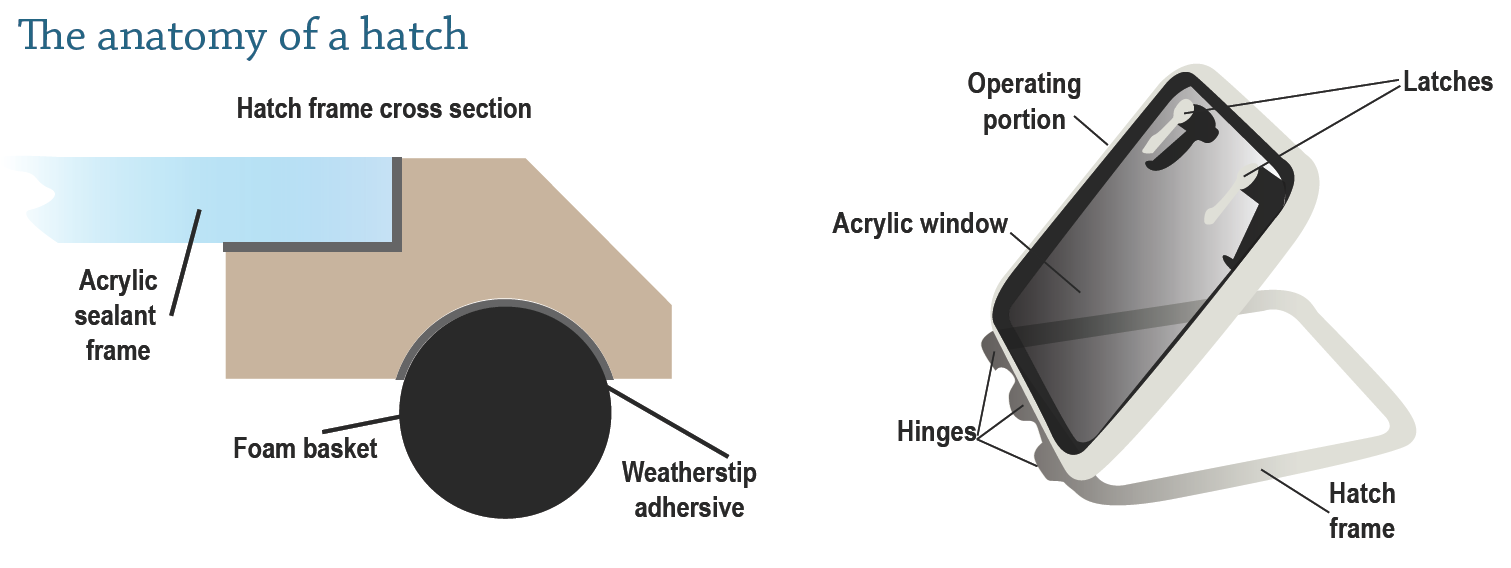
What to study: a “leaking hatch” can fail at the acrylic-to-lid bond, compression gasket, handles or hinges, or frame-to-deck bedding. Dry and test one boundary at a time before rebedding the entire unit. Image/source: Sailing Magazine, “Deck hatch maintenance”.

What to study: photograph maker, size and date codes before ordering seals, acrylic or hardware; visually similar hatch families use different parts. Image/source: Lewmar Hatch & Portlight Identifier.
Further learning: Study: Lewmar hatch and portlight identification · Watch: Diagnosing and repairing a leaking Lewmar hatch
Why it matters for an ocean crossing
Hatches and windows must withstand boarding water. A failed forward-hatch bond or broken lens can flood the cabin. Persistent leaks rot deck core and interior joinery, damage electronics and create mildew. Offshore escape hatches must open and be reachable, while all latches must secure positively. Tropical UV accelerates lens and seal aging.
How age changes the answer
The age-band costs below are planning judgements derived from the unit and labor basis in “What it costs,” unless a source is named.
| Age at departure | What is normally justified | Typical cost |
|---|---|---|
| under 10 years | Hose test, clean seals, adjust handles and repair isolated leaks; usually do nothing. | $0–$800 |
| 10–20 years | Gaskets, handles or reglazing may be due conditionally. | $300–$4,000 |
| 20–30 years | Crazing, obsolete models and frame corrosion can favor complete replacement. | $1,000–$8,000 |
| over 30 years | Budget a prioritized glazing program, not automatic replacement of every dry unit. | $2,000–$15,000+ |
Exposure, frame movement and prior sealant work dominate. Dry 25-year-old hatches can remain serviceable; a newer bonded window installed with the wrong adhesive can fail. Doing nothing is correct when lens strength/clarity, latch engagement, seals and deck bedding pass inspection and hose testing.
Repair, service or replace
Service by cleaning channels, lubricating seals with approved products, replacing handle O-rings and adjusting friction stays/latches. Determine whether leakage is lens-to-frame, gasket or frame-to-deck before rebedding. Reglazing replaces acrylic and adhesive while retaining a sound frame; specialist shops can often reproduce obsolete lenses.
Replace the complete unit when frame corrosion/distortion, unavailable parts, poor emergency-opening function or repair economics justify it. Bonded hull windows require the correct engineered adhesive, surface preparation, gap and mechanical support; household sealant or through-bolting acrylic without design allowance can create cracks.
What it costs
| Item | Unit | Bay Area 2026 |
|---|---|---|
| Gasket/handle/O-ring service | opening | $200–$600 (judgement) |
| Rebed hatch/port frame | each | $600–$1,800 (judgement) |
| Reglaze existing hatch | each | $800–$2,000 (judgement) |
| Lewmar Size 3 opening portlight | part | about $372–$458 current retail |
| Replace standard portlight | installed | $900–$2,000 (judgement) |
| Replace medium/large hatch | installed | $1,500–$3,500 (judgement) |
| Replace large bonded window | each | $2,000–$6,000+ (judgement) |
| Multiple-opening program | boat | $5,000–$15,000+ (judgement) |
Interior trim removal, core repair and finish matching can exceed the lens price. Identify exact model from stamped code before ordering. Do not assume every drip means a new $1,500 hatch.
What a pre-purchase survey tells you
- Covered by a standard survey — visible crazing/cracks, frame corrosion, latch/stay operation, evidence of leaks and hose testing if arranged. Deck moisture around frames is standard survey territory.
- Not covered — removal to identify hidden core damage, bond-strength testing, destructive glazing inspection and guaranteed hose testing under all directions. A glazing specialist quote is sensible before purchase for large bonded-window movement, deep cracks or multiple active leaks; isolated gasket leaks can be handled after purchase.
What to ask
- The broker or owner — “Send invoices for every gasket, reglaze, rebed or replacement and identify manufacturer/model/size.” “Which openings leak, under what wind/wave direction, and what repair was attempted?” “Have any windows moved, debonded or cracked after hull flex?”
- The surveyor — “Hose-test systematically while an observer remains below, map deck moisture around frames, operate every latch/stay/escape opening and identify whether leakage is glazing, gasket or deck bedding where possible.”
What you can see yourself
Read and photograph lens codes. Look across acrylic in low-angle light for deep crazing and around holes/corners for cracks. Close a strip of paper in the gasket and pull; uneven resistance shows poor compression. Hose from low to high so water does not disguise the source. Press gently on bonded windows and watch the adhesive edge. Inside, look for staining, soft headliner, corroded screws and fresh sealant beads over old dirt.
Getting the estimate wrong
Do not replace a complete hatch for an O-ring or gasket. Do not call cosmetic crazing structural without depth/extent, but do not ignore cracks at fasteners. Rebed and reglaze are different joints and alternative scopes. Avoid counting deck-core repair twice. Model/version identification is essential: “Lewmar hatch, 1998” is not enough. A smear of silicone is not a durable rebedding allowance.
Recommended learning and sources
- Lewmar Ocean hatch seal example — illustrates gasket-specific service rather than generic caulking
- Lewmar hatch and portlight identification by lens code
- Lewmar current hatch/portlight range
- Lewmar New Standard portlight product information
- Current Lewmar Size 3 retail example
- Current Lewmar hatch/portlight price list example