What it is
An autopilot has a heading/motion sensor, control head, course computer, rudder-angle sensor where required and a drive that moves the rudder. A below-decks linear drive is an electric or hydraulic ram connected to a dedicated tiller arm. A rotary drive turns steering chain or gears. A cockpit wheel pilot drives the wheel and is generally a lighter-duty solution. The computer must be matched to drive current and the drive must be sized for the boat's loaded displacement, steering type and rudder load—not length alone.
Windvane self-steering uses apparent wind and boat motion rather than electricity. A servo-pendulum vane pulls the main tiller/wheel; an auxiliary-rudder system such as Hydrovane steers with its own rudder and can provide emergency steering. These are alternatives or redundancy, not components of the electronic pilot.
Owner learning layer
sensing, deciding and moving
Mental model
An electronic pilot senses heading and motion, compares them with a target, and commands a drive that applies steering force. Performance depends on clean heading data, correct commissioning, enough electrical power, proper drive geometry and a balanced sail plan. The pilot should make small corrections; constant large corrections usually indicate excess sail, poor trim, sea-state limits, calibration or mechanical friction—not merely a weak computer.
Tradeoffs
Wheel pilots are inexpensive and easy to fit but expose the drive and typically have limited duty cycle. A below-decks linear or rotary drive is stronger and protected, though installation geometry and structural attachment are critical. Oversizing can increase robustness but also current and mechanical loads; undersizing creates chronic overwork. Steering to apparent wind can preserve sail balance but relies on good wind data. Windvane steering saves energy and offers independent logic; it adds stern hardware, learning and performance constraints. Two control heads are not redundant if both depend on one sensor, computer and drive.
Maintenance competence
Identify every component, breaker, fuse, network connection, clutch/release and tiller-arm attachment. Know loaded displacement and the drive’s rating. Inspect mounts and fasteners, test rudder-angle feedback and alarms, keep the heading sensor area free of magnetic changes, and commission after material sensor/software changes. Practice disengaging the drive instantly and steering manually. Record current draw in calm and rougher conditions; rising draw can reveal friction or poor balance. For offshore use, carry a realistic manual/self-steering fallback and prove it before departure.
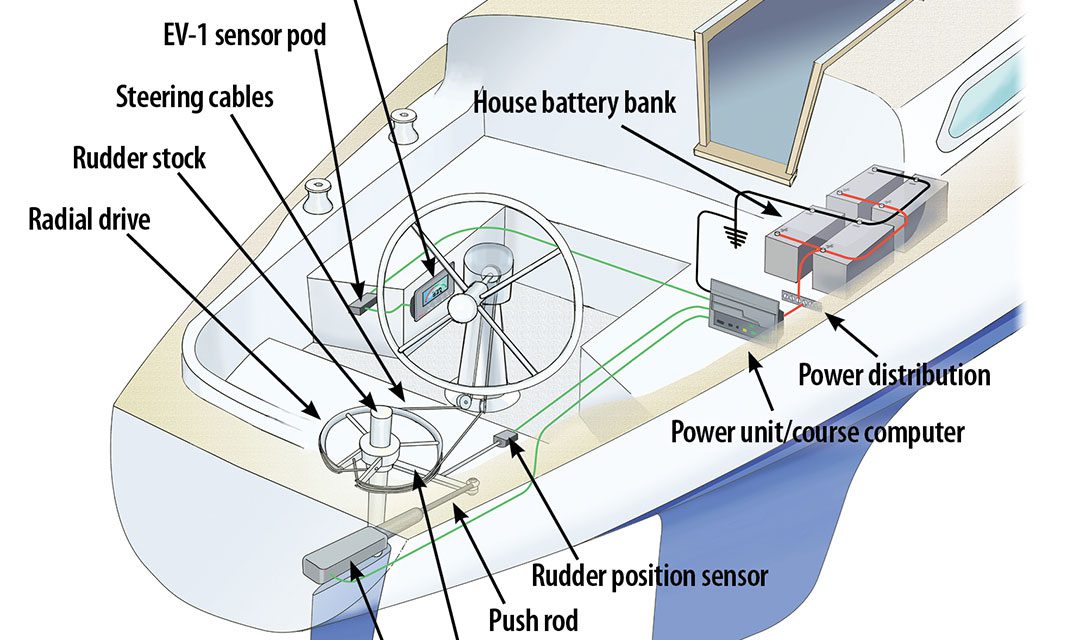
What to study: the pilot is a closed control system—heading sensor to course computer, course computer to drive, drive to a structurally mounted tiller arm, with rudder-angle feedback where fitted. Pay special attention to the drive shelf, pin geometry, independent tiller arm, power feed, network and manual isolation. Image/source: Good Old Boat, “Autopilot Installation”.
Further learning: Study: Raymarine guide to autopilot components · Watch: Raymarine Evolution sailboat installation
Why it matters for an ocean crossing
Two people cannot hand-steer continuously for weeks. The pilot is operationally critical and often one of the largest passage electrical loads. Undersized drives overheat or break in quartering seas; weak mounting structures fail even when electronics work. A balanced sail plan dramatically reduces load. Redundancy may be a spare drive, repair parts, independent windvane or a practiced method of sheet-to-tiller steering.
How age changes the answer
The age-band costs below are planning judgements derived from the unit and labor basis in “What it costs,” unless a source is named.
| Age at departure | What is normally justified | Typical cost |
|---|---|---|
| under 7 years | Inspect mount/wiring, calibrate and heavy-weather test; usually do nothing. | $0–$1,000 |
| 7–12 years | Service drive seals/brushes as applicable; check sensor/network support and carry spares. | $500–$3,000 |
| 12–20 years | Obsolescence and accumulated drive wear may justify staged replacement before departure. | $2,000–$8,000 |
| over 20 years | Budget modern core/drive if unsupported or unreliable, but retain sound independent components where compatible. | $5,000–$15,000+ |
Electronics age, drive duty cycle, water ingress and installation quality matter more than a simple interval. A lightly used 12-year-old below-decks drive can be valuable; a three-year-old undersized wheel pilot is not an offshore solution for a heavy 42-footer. Do nothing after testing when the system is correctly sized, supported, dry, structurally sound and can steer the boat in representative seas without overheating or excessive current.
Repair, service or replace
First balance sails and remove steering friction. Service connectors, calibration, rudder reference and manufacturer-approved drive wear items. A faulty control head does not require a new ram; a worn ram does not always require replacing a compatible computer. Carry the components most likely and feasible to change—drive belt/motor/brushes or a complete spare ram where practical.
Upgrade when the drive is undersized, mounted to weak structure, unsupported by its computer, or demonstrably unable to steer the loaded boat. An independent windvane adds resilience and reduces power use but requires stern geometry, installation, learning and sail balance. It is not automatically justified on every two-handed boat with a robust spare-drive strategy.
What it costs
| Item | Unit | Bay Area 2026 |
|---|---|---|
| Diagnostic/calibration | job | $500–$1,500 (judgement) |
| Raymarine EV-400 core pack, no drive | part | $2,799.99 posted |
| Raymarine EV-200 with Type 1 linear drive | pack | $4,199.99 posted |
| Type 2-class below-decks drive | part | $2,500–$5,000 (judgement by type) |
| Custom tiller arm | part | $684–$887 posted |
| Structural mount/fabrication | job | $1,000–$4,000 (judgement) |
| Complete robust electronic pilot | installed | $7,000–$15,000 (judgement) |
| Duplicate drive/spare strategy | added | $2,000–$6,000 (judgement) |
| Windvane self-steering | installed | $7,000–$12,000 (judgement; stern brackets/access) |
Raymarine separates the EV-400 sensor/computer/control pack from the mechanical/hydraulic drive. Quoting only the $2,800 pack as a “complete offshore autopilot” is wrong. Installation includes heavy DC wiring/fuse, network, rudder sensor, tiller arm, stops and a mount able to carry full steering load.
What a pre-purchase survey tells you
- Covered by a standard survey — powers on, engages, turns the helm, basic sea-trial course holding, visible drive/mount/wiring and obvious leaks/noise. Many surveys test only in calm water.
- Not covered — loaded-displacement sizing calculation, sustained rough-water current/temperature, internal drive wear, network diagnostics and structural engineering of hidden mounts. An electronics/steering specialist review ($500–$1,500) is worth doing before purchase when the pilot is a major advertised asset, old/obsolete, noisy, leaking, or the drive type/model is unknown.
What to ask
- The broker or owner — “Send the model and serial for computer, sensor, control head, rudder sensor and drive—not just the brand.” “Send purchase/service invoices and a photo of the drive-to-tiller-arm mounting.” “Has it ever disengaged, overheated, blown fuses or failed in following seas?” “What is the measured current draw in calm and rough conditions?”
- The surveyor — “Identify every component and drive rating; inspect structure, pins, stops and tiller arm; test compass agreement and rudder feedback; and run course changes under power and sail. State what remains untested rather than calling power-on a pass.”
What you can see yourself
Find the actual drive. Look for oil, rust, loose pins, elongated holes, flexing plywood and a hose/wire that can snag. Engage the pilot at the dock only when safe and listen through full travel. At sea, command 20–30-degree turns on both tacks and watch whether the mount flexes or clutch slips. Compare pilot heading with a separate compass. Record current draw and feel the drive after sustained work. For a windvane, check bearing play, bracket cracks, spare vanes and whether the auxiliary rudder can be shipped safely from the boat.
Getting the estimate wrong
Do not equate a control head at the helm with a complete, suitable autopilot. The drive—not the display—is the key hardware. Do not price a new pilot when a serviceable below-decks drive is already installed without first testing compatibility. Avoid double-counting tiller arm and steering repairs. Size from loaded displacement and steering torque, not LOA or empty brochure weight. Do not treat a wheel pilot as equivalent to a Type 1/2 ram, and do not count a windvane as zero-cost emergency steering without installation and practice.
Recommended learning and sources
- Raymarine guide: the four components of a boat autopilot
- Raymarine Evolution setup and commissioning guide
- Raymarine EV-400 Sail pack contents and price
- Raymarine EV-200 Sail pack with drive pricing
- Raymarine guide to selecting a drive and control unit
- Edson custom autopilot tiller-arm pricing
- Hydrovane system and emergency-rudder description